




Access advice to guide your steps
For two decades, Australia's approach to reducing smoking has leaned heavily on one lever: tax it until people stop buying it. On paper, that's a reasonable public health strategy. In practice, the numbers now tell a very different story; one where legal cigarette sales have collapsed, but overall tobacco consumption hasn't fallen nearly as much, because an enormous illegal market has stepped in to fill the gap. The federal budget is now feeling the consequences.
Tobacco excise is one of Australia's oldest and most reliable revenue sources, until recently. Federal tobacco excise revenue peaked at $16.3 billion in the 2019–20 financial year. This year, Treasury expects to collect just $7.4 billion, roughly half what it was five years ago, and the lowest in over a decade.
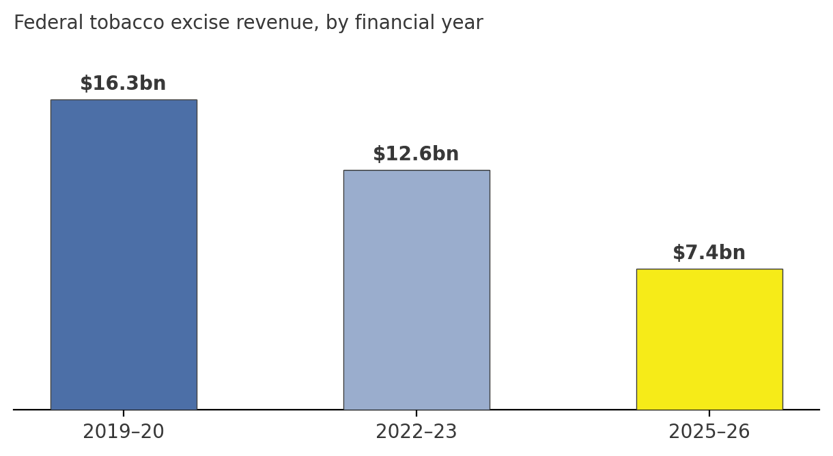
This isn't a one-off dip. In the most recent federal budget, Treasury downgraded its tobacco excise forecasts by a further $8 billion over the next five years. Current projections put total excise revenue at around $22.3 billion across 2026 to 2028; down from a forecast of $44.9 billion for the same period made only two years earlier. The trend has been consistently, and increasingly, downward.
The explanation isn't that Australians have simply given up cigarettes at the rate the tax was designed to encourage. Between 2016 and 2025, the price of a legal pack of cigarettes nearly tripled, driven by annual indexation plus a run of additional above-inflation increases. Illicit cigarette prices, by contrast, have stayed roughly flat over the same period, creating a widening price gap that's pulled an enormous number of smokers into the black market.
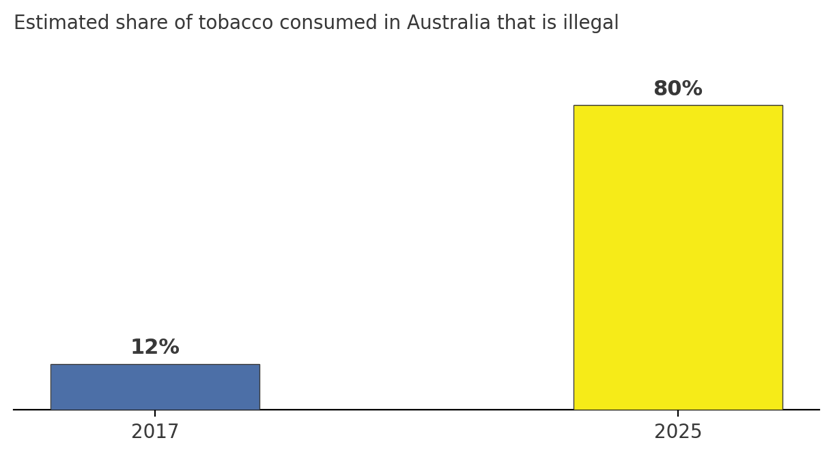
New analysis from the Australian Bureau of Statistics, the first serious attempt by government to size this market, estimated that 80% of the tobacco consumed in Australia in 2025 was illegal, up from just 12% in 2017.
Australia's Illicit Tobacco and E-cigarette Commissioner estimates that excise and duty evasion cost the federal budget up to $11.8 billion in the 2024–25 financial year alone, more than the entire legal excise take collected that year. The illicit trade has also become a serious law enforcement problem in its own right, with organised crime networks reportedly using arson and extortion to control territory in the illegal cigarette market.
This has become a genuinely contested policy question, and it doesn't split cleanly along the usual lines. One senator, Pauline Hanson, has publicly called for tobacco excise to be reduced, arguing that pricing legal cigarettes so far above the black market alternative has done little to reduce nicotine consumption while destroying the tax base and handing an enormous, violent market to organised crime. Notably, this view has found some unexpected support; former deputy chief medical officer Nick Coatsworth has also backed a cut to excise, breaking from the position most public health figures hold.
The counter-argument is that cutting excise is not guaranteed to solve the problem it's aimed at. Critics point out that a lower legal price may not undercut illicit prices enough to shift consumption back to the legal market, and that some states, Western Australia among them, have shown rising smoking rates even amid the illicit trade boom, suggesting the picture is more complicated than "excise up, smoking down" or "excise down, problem solved." There's also the broader public health concern that any softening of tobacco taxation risks reversing decades of gradual decline in smoking rates.
Tobacco is, in my view, a pretty clear moral hazard; I'll admit I don't fully understand paying money for something designed to cause yourself harm. But I do think meaningful substances like this should be controlled and regulated in some form, rather than left entirely to an unregulated black market. Whatever the right policy answer is here, the current settings don't look like they're achieving either goal; the budget is losing billions, and the product is more available than ever, just now via organised crime instead of a licensed retailer.
Tax policy debates like this one rarely stay contained to the topic at hand. A federal budget missing billions in previously reliable revenue has to find that money somewhere else; whether through other tax settings, spending decisions, or simply running a larger deficit than planned. It's a useful reminder that government revenue forecasts can shift meaningfully based on how people actually respond to a policy, not just how the policy was designed to work on paper.



This website may contain general advice, but does not take into account your objectives, financial situation or needs. You should consider whether the advice is suitable for you and your personal circumstances. Before you make any decision about whether to acquire a certain product, you should obtain and read the relevant product disclosure statement. In the event that Funded Futures Financial Services is providing personal advice it will be communicated via a ‘statement of advice’.
Funded Futures Financial Planning ABN 81 646 656 804 T/A Funded Futures Financial Services is a Corporate Authorised Representatives and is authorised through Cobalt Advisers Pty Ltd ABN 64 628 654 099 who is an Australian Financial Services Licencee # 512550.
© 2024 Funded Futures | All Rights Reserved | Developed by
