




Access advice to guide your steps
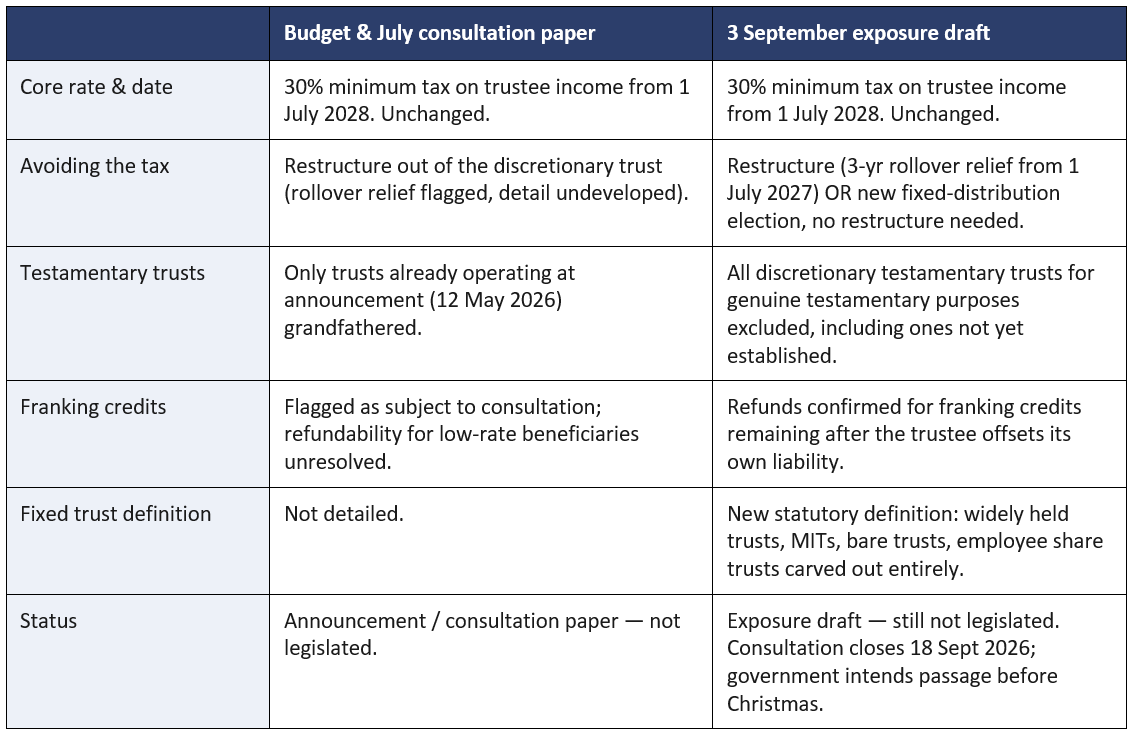
Treasurer Jim Chalmers released exposure draft legislation on 3 September 2026 for the 30% minimum tax on discretionary trusts. This builds on the consultation paper released in July, and it's the third round of adjustments to the policy since it was first announced in the 2026-27 Budget on 12 May.
The headline change is a genuine third pathway for trustees. Previously the choice looked binary: absorb the 30% minimum tax at trustee level, or restructure out of the discretionary trust (with rollover relief softening the income tax and CGT consequences, but not necessarily the stamp duty – as that is State Level). The exposure draft adds a middle option: a fixed-distribution election.
- A discretionary trust can elect to make fixed distributions to pre‑nominated beneficiaries; individuals, eligible companies or eligible trusts, with no stated cap on numbers.
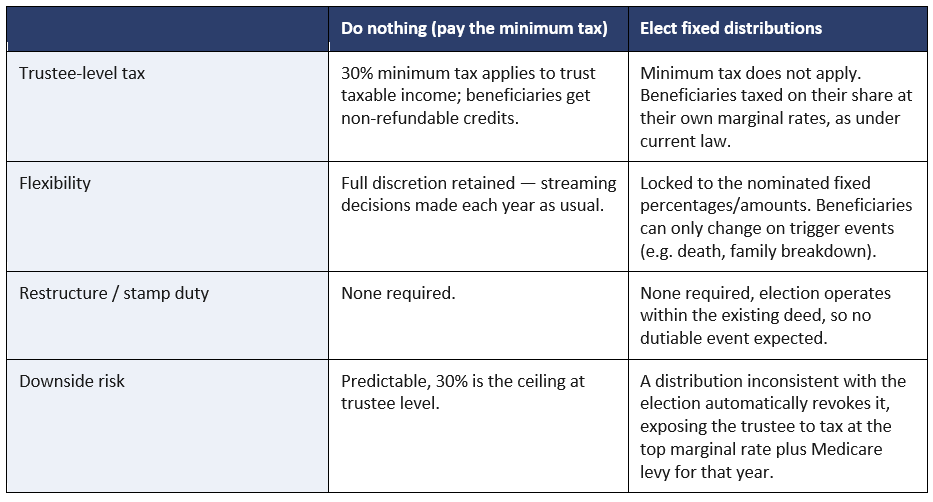
- The election operates within the existing deed. There's no restructure, and it isn't expected to trigger state or territory stamp duty.
- Beneficiaries can only be added or changed following trigger events such as death or family breakdown; not at ordinary trustee discretion.
- All discretionary testamentary trusts established for genuine testamentary purposes are now excluded; not just ones already operating at the May announcement.
- Franking credit refunds are confirmed for credits remaining after the trustee offsets its own minimum tax liability.
- A new statutory fixed trust definition carves out widely held trusts, MITs, bare trusts and employee share trusts entirely.
The fixed-distribution election is not a conversion to a unit trust. The deed keeps its discretionary character; the trustee is electing into a tax treatment, not changing the trust's legal form. That distinction is exactly why the government expects no stamp duty event: there's no change in beneficial ownership to tax.
But it's a real trade, not a free kick. Once elected, distributions have to track the nominated fixed percentages or amounts, year after year, regardless of what happens to profits, cash flow or a beneficiary's own tax position. A distribution that departs from the elected arrangement automatically revokes the election — and exposes the trustee to tax at the top marginal rate plus Medicare levy for that year, which is materially worse than the 30% it was designed to avoid.
This is exposure draft, not bill text. The mechanics above are drawn from the Treasurer's media release and early practitioner commentary, the underlying legislative wording hasn't been independently verified against the primary draft yet.
It isn't yet clear whether an election can apply to part of a trust's income while the balance remains genuinely discretionary, or whether it's all‑or‑nothing once made. Treat this as open until the draft bill text (not press commentary) confirms it.
The sporting-club distribution cap and the exact scope of “genuine testamentary purposes” are both still subject to consultation.
For a trading trust with, say, $300,000 of taxable income and beneficiaries on a spread of marginal rates, the two live pathways once the minimum tax applies look like this:



This website may contain general advice, but does not take into account your objectives, financial situation or needs. You should consider whether the advice is suitable for you and your personal circumstances. Before you make any decision about whether to acquire a certain product, you should obtain and read the relevant product disclosure statement. In the event that Funded Futures Financial Services is providing personal advice it will be communicated via a ‘statement of advice’.
Funded Futures Financial Planning ABN 81 646 656 804 T/A Funded Futures Financial Services is a Corporate Authorised Representatives and is authorised through Cobalt Advisers Pty Ltd ABN 64 628 654 099 who is an Australian Financial Services Licencee # 512550.
© 2024 Funded Futures | All Rights Reserved | Developed by
