




Access advice to guide your steps
Federal government spending sat at 26.9% of GDP in 2025-26. Outside the COVID years, that's the highest it's been since 1986. Layer state government deficits on top; Victoria alone ran a $2.2 billion deficit in 2024-25, with net debt tracking toward $187.8 billion by 2028. and you get a genuinely uncomfortable picture of how much of the economy is currently being run by government decision rather than market decision.
Here's the part that actually bothers me, though. It's not really the spending. Governments have always spent, that's the job. It's that nobody with real authority seems willing to say out loud that it's a problem.
The RBA governor, Michele Bullock, has been asked directly and repeatedly whether government spending is adding to inflation. Her answers have been careful almost to the point of evasive, spending is “one of many contributors,” alongside low unemployment, tax cuts and rising real incomes. When pressed, she'll concede that slower public spending growth “would help,” but she won't say it's the cause. And to be fair to her, that's not spin; it's the RBA staying inside its lane. Monetary policy is her job; fiscal policy is the government's, and the RBA has always been careful not to be seen telling elected governments how to spend.
But that carefulness is exactly the problem. The Treasurer gets to say “the RBA's own statement doesn't mention government spending” and walk away clean. The RBA gets to say “we just respond to demand, wherever it comes from” and stay above the political fight. Meanwhile spending stays elevated, nobody with the authority to say “stop” is willing to say it plainly, and the people actually paying for it, through higher rates on their mortgage, are the last ones in the loop to find out why.
The chart below is the part I find most telling; shown two ways, because the two versions make the point a little differently and I'd rather you saw both than have me pick one for you.
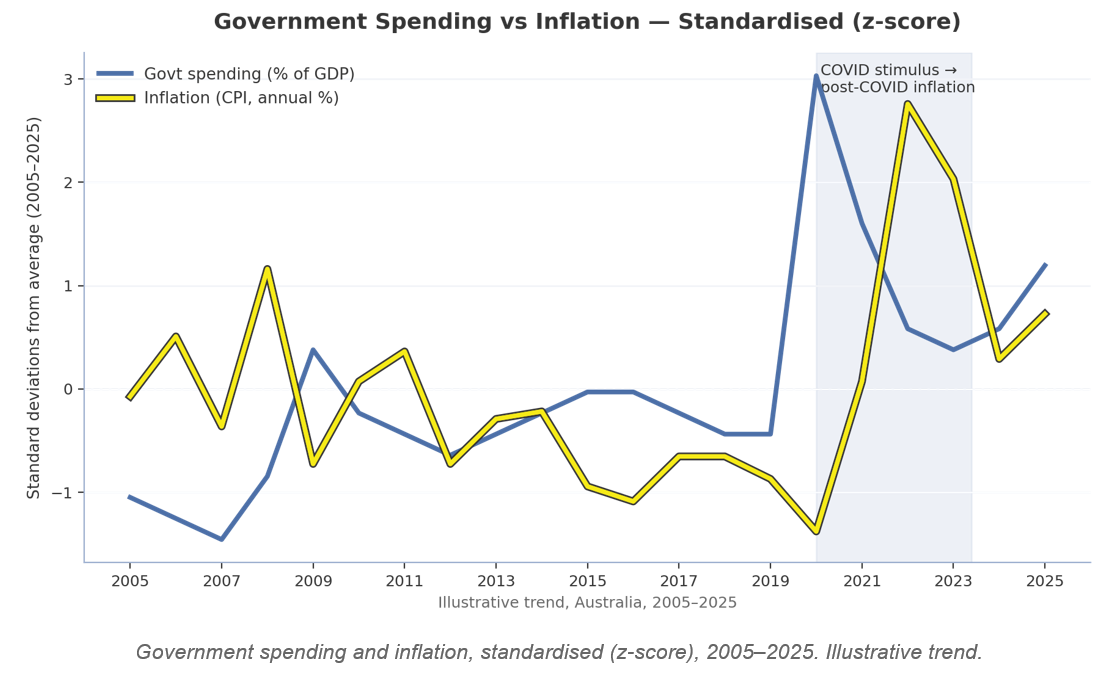
This first version puts both series on the same scale, how far each is from its own long-run average, so you can see them move together. Before 2020 they're loosely related at best. From 2020 they spike together and stay elevated in lockstep through to 2023, before both easing back.
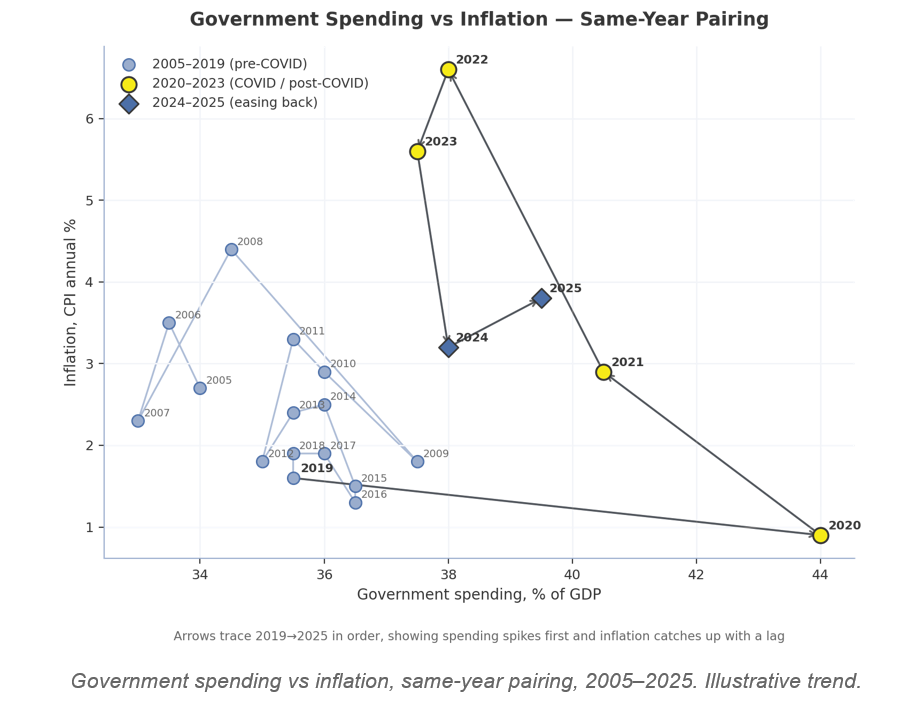
This second version plots the same two numbers against each other year by year, with arrows tracing 2019 through to 2025 in order. The pre-COVID years are a shapeless little cluster, no obvious pattern. Then watch what happens from 2020: spending rockets out to 44% of GDP while inflation is still near zero, the stimulus hadn't hit the economy yet. It's only by 2022-23, after spending had already started easing back, that inflation actually peaks. That lag is the whole story: the money that went out the door in 2020 and 2021 didn't show up as higher prices until a year or two later, by which point most people had stopped connecting the two.
Which is where we are now. We're living through the lag from spending decisions made years ago; decisions that were broad, fast, and not especially targeted. Money went out the door quickly and generally, rather than being aimed at the businesses and sectors that actually had spare capacity to absorb it, and an economy already running close to full tends to turn extra demand into higher prices rather than more output. The government can point out, accurately, that spending isn't climbing further; it's basically flat at this elevated level. But flat at 26.9% of GDP isn't the same as coming down, and “not getting worse” isn't cost-of-living relief. If you're genuinely trying to take pressure off inflation, the lever that's still available is turning spending back down toward where it used to sit, and that's the lever nobody in government wants to touch, because cutting spending in front of an election is how you lose one.
None of this is a call for austerity, and I'm not pretending the maths is as simple as “spending down, rates down.” But I think we've drifted into an era where spending decisions get made with one eye on the next election rather than the next decade, and where the people whose job it is to check that, an independent central bank, a fourth estate, an opposition, all have their own reasons not to make it simple to follow. If you're the one paying the mortgage, that's worth understanding, even if you can't do much about it.



This website may contain general advice, but does not take into account your objectives, financial situation or needs. You should consider whether the advice is suitable for you and your personal circumstances. Before you make any decision about whether to acquire a certain product, you should obtain and read the relevant product disclosure statement. In the event that Funded Futures Financial Services is providing personal advice it will be communicated via a ‘statement of advice’.
Funded Futures Financial Planning ABN 81 646 656 804 T/A Funded Futures Financial Services is a Corporate Authorised Representatives and is authorised through Cobalt Advisers Pty Ltd ABN 64 628 654 099 who is an Australian Financial Services Licencee # 512550.
© 2024 Funded Futures | All Rights Reserved | Developed by
