



Access advice to guide your steps
I bought and sold shares to save for my first home deposit. Under the capital gains tax rules that start on 1 July 2027, that would have cost me a lot more tax than it did.
Most of the noise around the new rules has been about property. But the changes apply to shares, ETFs and most other investments too. And one detail is getting almost no attention: a 30% minimum tax on capital gains. For anyone whose marginal rate is below 30%, which means anyone with income under about $45,000, that floor is a tax increase. These aren't wealthy investors. Plenty of them are young people saving for a deposit.
The reforms passed Parliament in June 2026 and take effect from 1 July 2027. For individuals, trusts and partnerships, two things change:
• The 50% CGT discount goes. Today, an asset held for 12 months or more has half its gain taxed. From 1 July 2027 it is replaced by cost base indexation: the purchase price is increased for inflation (using CPI), and only the gain above that is taxed. Indexation needs a holding period of at least 12 months.
• A 30% minimum tax applies to capital gains. If the tax on the gain at your normal marginal rates comes to less than 30% of the gain, an additional amount tops it up to 30%.
The top-up works by comparing two numbers: 30% of the gain, and the extra tax the gain actually adds to your bill at your normal rates. If the first is bigger, you pay the difference. For anyone whose marginal rate is below 30%, which is everyone with taxable income (including the gain) under $45,000, the floor applies.
There is no general low-income exemption. The main exemption is for recipients of certain income support payments, which the legislation is intended to cover, such as the Age Pension, JobSeeker, Disability Support Pension and Parenting Payment. Companies and super funds are not affected.
What it looks like in dollars
Take shares bought for $20,000 and sold for $30,000 after 1 July 2027, held for more than 12 months. The gain is $10,000. Assume inflation over the holding period adds $1,000 to the cost base, so the indexed gain is $9,000. The table compares the tax on that gain under today's rules and the new rules, using the 2027–28 resident tax rates for both so that only the CGT change shows. All figures are before Medicare levy and offsets.
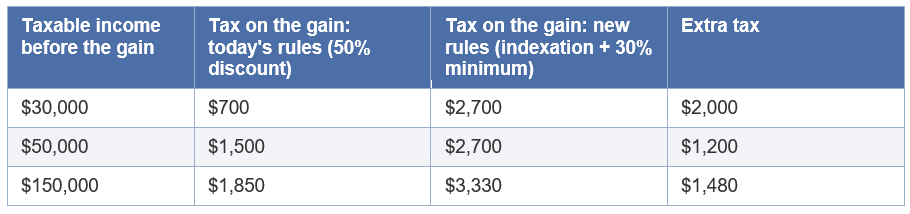
The $30,000 earner pays almost four times as much. Their normal rate on the gain is 14%, which would be $1,260 on the indexed gain, so the 30% floor adds a further $1,440 to reach $2,700. The other two rows are above the 30% marginal rate already, so the floor adds nothing. They pay more simply because the discount is gone.
That's the second catch. A 50% discount takes half the gain out of tax. Indexation only removes the part of the gain that is inflation. In this example that's 10% of the gain. Indexation comes out ahead of the discount only when inflation accounts for more than half of the gain, which means long holding periods with little real growth. For most shares held for a few years, it won't.
The headlines are about housing because the Budget bundled the CGT changes with a limit on negative gearing for established residential property. That limit is property-only. The CGT change is not.
The discount-to-indexation switch and the 30% minimum apply to CGT assets held by individuals, trusts and partnerships. That includes shares, ETFs and managed funds, and other assets such as crypto, not just investment property. The main residence exemption is unchanged, and shares are not caught by the negative gearing limit. But a gain on shares sold after 1 July 2027 is a gain under the new rules.
That matters for the people least likely to be following the property debate: young investors building a deposit, or adults saving for a goal, with modest incomes and a share or ETF portfolio they plan to sell.
The new rules don't reach back. Gains that build up before 1 July 2027 are still worked out under the current law, including the 50% discount. For assets held by individuals and trusts on 30 June 2027, the law treats them as sold just before 1 July 2027 and re-bought at market value, or under an apportioning method the Government is still to set. The gain or loss from that deemed sale is deferred until you actually sell.
In practice, three things are worth thinking about:
• The 30 June 2027 value is now an important number. It's the starting point for the new regime, so records of what each holding was worth on that date will matter.
• A sale isn't forced. Because the deemed sale defers the gain, the pre-July 2027 gain keeps its discount without you selling anything. Selling early to "beat the deadline" should be weighed against what it costs, not assumed to be a win.
• Deductions don't shelter the floor. The 30% minimum is worked out on the gain itself. Reducing your taxable income with deductions can mean a bigger top-up, not a smaller tax bill.
Two details are worth confirming against the final law and ATO guidance as it arrives: how assets held for less than 12 months are treated, and the apportioning method, which is still to be set.
If you hold shares, ETFs or other investments outside super, particularly if you're saving toward a goal like a home deposit, it's worth understanding what your unrealised gains look like before 1 July 2027. Get in touch with the team at Funded Futures and we'll walk through your situation with you.



This website may contain general advice, but does not take into account your objectives, financial situation or needs. You should consider whether the advice is suitable for you and your personal circumstances. Before you make any decision about whether to acquire a certain product, you should obtain and read the relevant product disclosure statement. In the event that Funded Futures Financial Services is providing personal advice it will be communicated via a ‘statement of advice’.
Funded Futures Financial Planning ABN 81 646 656 804 T/A Funded Futures Financial Services is a Corporate Authorised Representatives and is authorised through Cobalt Advisers Pty Ltd ABN 64 628 654 099 who is an Australian Financial Services Licencee # 512550.
© 2024 Funded Futures | All Rights Reserved | Developed by
