




Access advice to guide your steps
The "super death tax" comes up in client conversations more than you'd expect, and the confusion is almost always the same. There's no tax on dying. But super can be taxed when it's paid out after death, and whether it is depends on who receives it.
The trap is that the law uses the word "dependant" twice, with two different meanings. One decides who the fund is allowed to pay. The other decides who pays tax. A person can be a dependant for the first purpose and not for the second, and adult children are the classic example.
Under superannuation law (the SIS rules), a dependant is someone the fund is allowed to pay a death benefit to. That includes a spouse, a child of any age, a person in an interdependency relationship, and a financial dependant.
Under tax law, a dependant is someone who gets the benefit tax-free. That list includes a spouse, a former spouse, a child under 18, a financial dependant and a person in an interdependency relationship.
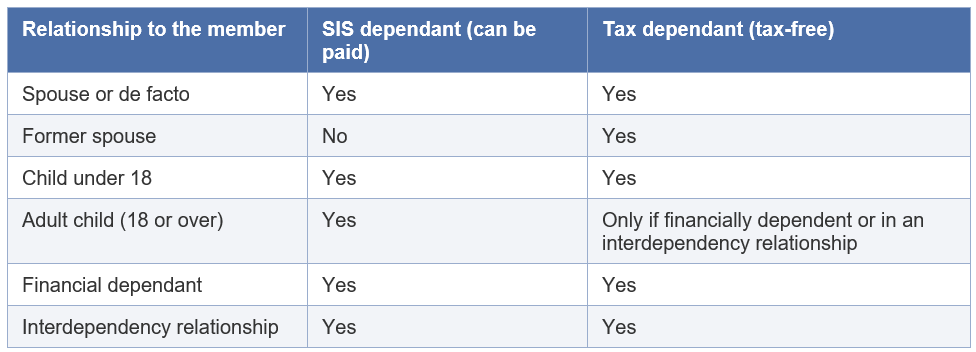
The adult child row is where people get caught. A financially independent adult child can be paid directly by the fund, but doesn't get the tax-free treatment. A nomination decides who the fund pays. It doesn't decide who pays tax.
There's a second layer for pensions. Super law only lets a death benefit be paid as a pension to certain people, such as a spouse, a child under 18, a child under 25 who is financially dependent, or a child with a qualifying disability. An adult child outside those groups must receive a lump sum.
A super balance has two parts. The tax-free component has already been taxed, and usually comes from non-concessional (after-tax) contributions. The taxable component is everything else, including employer contributions, salary-sacrificed amounts and investment earnings. When a lump sum death benefit is paid, it's split between the two in the same proportion as the member's balance.
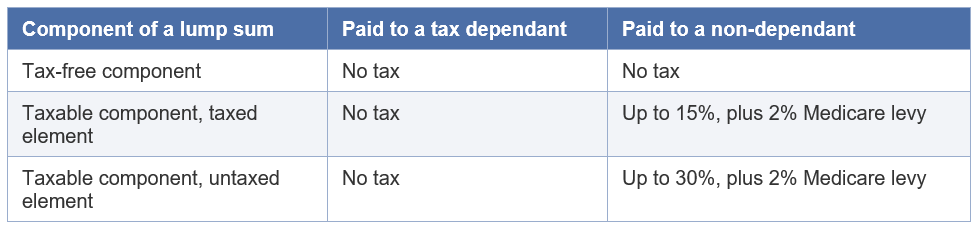
Most people's super is a taxed element, so the figure that matters for most families is 17% (15% plus the Medicare levy) on the taxable component. The tax-free component passes to a non-dependant without further tax.
If the benefit is paid to the deceased estate instead, the tax depends on who ends up with the money. Where all the beneficiaries are non-dependants, the trustee pays the same 15% and 30% rates on the taxable component. Where they're a mix of dependants and non-dependants, only the share going to non-dependants is taxed.
Take a member who dies with $800,000 in super, the same balance produces very different results depending on who receives it and how much of it is tax-free.
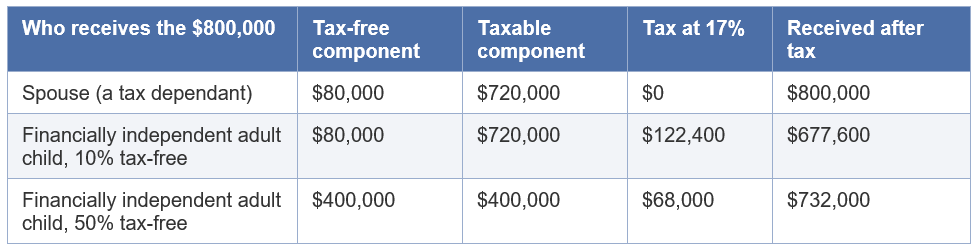
The fund can pay the adult child in either case. The difference is that a spouse pays no tax at all, while the adult child pays 17% of the taxable component. And the more of the balance that is tax-free, the less that is. In this example, shifting the mix from 10% to 50% tax-free saves $54,400 for the same $800,000.
The example assumes a lump sum paid directly to the individual, a taxed element throughout, and the full 17% rate. It ignores any other tax the recipient may pay.
The split between tax-free and taxable components isn't fixed. Once someone can access their super, which is generally from age 65, or from 60 if they've retired, withdrawals are generally tax-free. That opens up options that aren't available earlier, because the mix inside the fund can be changed while the member is still alive.
One approach that gets talked about is a recontribution strategy. It involves withdrawing money from super and contributing it back as a non-concessional contribution, which can increase the tax-free component without changing the total balance. The aim is usually to reduce the tax that non-dependant beneficiaries, such as adult children, pay later. Most people who use it do so for their children, not for themselves.
It isn't suitable for everyone, and whether it makes sense depends on things like:
• Your age, and whether you can still make non-concessional contributions. They generally can't be made after 75.
• Your total super balance. The non-concessional cap for 2026–27 is $130,000, but it's nil if your total super balance is $2.1 million or more.
• What your super is invested in, and whether assets would need to be sold.
• How it interacts with the Age Pension and other entitlements.
• Whether reducing tax for your beneficiaries is actually what matters most to you.
That's a long list for a general article, and it's why this is a conversation rather than a how-to. The right answer depends on your family, your balance and what you want to leave behind.
If you're 60 or over and hold super, the tax your children could face on it isn't set in stone. In some cases it can be improved while you're still here, for you and for them. Get in touch with the team at Funded Futures and we'll look at your situation with you.


This website may contain general advice, but does not take into account your objectives, financial situation or needs. You should consider whether the advice is suitable for you and your personal circumstances. Before you make any decision about whether to acquire a certain product, you should obtain and read the relevant product disclosure statement. In the event that Funded Futures Financial Services is providing personal advice it will be communicated via a ‘statement of advice’.
Funded Futures Financial Planning ABN 81 646 656 804 T/A Funded Futures Financial Services is a Corporate Authorised Representatives and is authorised through Cobalt Advisers Pty Ltd ABN 64 628 654 099 who is an Australian Financial Services Licencee # 512550.
© 2024 Funded Futures | All Rights Reserved | Developed by
