

Access advice to guide your steps
Australia’s big four banks are some of the most profitable, most dependable businesses on the ASX. They make money in good times, they make money in bad times, and most of us own a slice of them whether we realise it or not (through super, an index fund, or a few shares we picked up years ago).
So here is a question worth sitting with: if the banks’ share prices fell from here, would that mean something had gone wrong with the banks?
Probably not. And understanding why tells you a lot about how investing in Australia really works.
A share price is not a report card. It is the price the market is currently willing to pay for a company’s profits.
Investors measure that with something called a price-to-earnings ratio (P/E). If a company earns $1 per share and the share costs $15, the P/E is 15. It is simply “how many dollars are people paying for each dollar of profit?”
That number can change even when the business doesn’t. A company can earn exactly the same profit next year and see its share price drop, purely because investors decided to pay 13 times those profits instead of 16.
That is the key idea for this article: a falling share price does not require falling profits. It only requires investors to change how much they’re willing to pay.
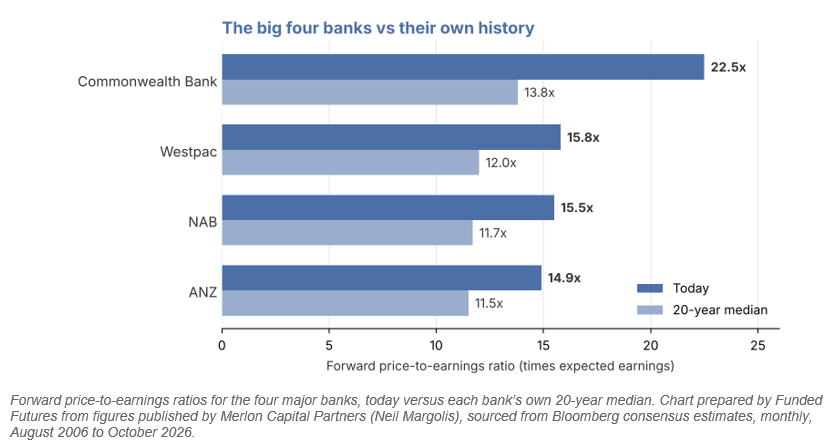
This article builds on research by Neil Margolis, Portfolio Manager at Merlon Capital Partners, in his piece Why we no longer own a major bank. Using Bloomberg consensus estimates, Merlon compared the forward P/E of the four major banks against their own history going back to 2006. The figures below are theirs, paraphrased and rounded.
The finding: all four are trading above their own 20-year median.
In the 2006 to 2011 period, all four traded at roughly 9 to 11 times earnings. The climb since then has been gradual, and it has not been the result of the banks suddenly becoming more profitable. They’ve simply been valued more generously.
To be clear, none of this is a forecast. A share can stay expensive for years (these have). It’s just a measure of the gap between what the banks cost now and what they have usually cost.
Two reasons stand out.
That creates a steady stream of buyers who are not very sensitive to price. When buying doesn’t depend on how expensive something is, prices can drift higher and stay there. (This deserves an article of its own. Stay tuned.)
Here is where it gets interesting for everyday investors.
When you can earn a decent, safe return from a term deposit or government bond, shares have to work harder to justify their price. The return on “doing nothing” (the risk-free rate) is the yardstick everything else is measured against.
If interest rates keep rising, or simply stay higher for longer, the maths changes. A dependable stream of bank profits looks a little less special when cash and bonds are paying you decently for taking almost no risk. Investors may reasonably decide they want a lower price for the same earnings.
If that happened, bank share prices could fall while the banks stayed just as profitable as ever. Profits unchanged, price lower. That is a re-rating, not a business failure.
It’s worth being clear about what we are not saying:
• We’re not saying the banks are bad businesses. They’re quite the opposite.
• We’re not saying their profits are about to fall.
• We’re not saying a fall is certain. The banks may never return to their long-run multiples. Expensive can stay expensive, and anyone predicting exactly when it ends is guessing.
• And there are fair arguments on the other side: banks overseas may be re-rating towards ours, regulators could ease capital requirements, and cost savings might stick.
What we are saying is that great business and great investment are not the same thing. The price you pay matters. A wonderful, reliable company bought at a very full price can still deliver a disappointing return, simply because the price was already assuming everything would go right.
If you own bank shares directly, or you own them through super or a managed fund (most Australians do), a few sensible questions to ask:
• How much of my portfolio is in the banks? Many Australians hold far more than they realise once super and direct shares are added together.
• What am I relying on them for? Income, growth, stability? Each of those can be affected differently by a change in valuation.
• Would a fall in price change my plans? If the answer is yes, that’s worth knowing before it happens, not after.
Headlines, when a share price drops, tend to say the company is in trouble. Sometimes it is. But sometimes the business is fine and the price was simply high. Knowing the difference is what helps you stay calm when markets move.
Not sure how much bank exposure you have across your super and personal investments? That’s something we can map out with you. Get in touch with the Funded Futures team to talk it through.
Funded Futures Financial Services Socials






This website may contain general advice, but does not take into account your objectives, financial situation or needs. You should consider whether the advice is suitable for you and your personal circumstances. Before you make any decision about whether to acquire a certain product, you should obtain and read the relevant product disclosure statement. In the event that Funded Futures Financial Services is providing personal advice it will be communicated via a ‘statement of advice’.
Funded Futures Financial Planning ABN 81 646 656 804 T/A Funded Futures Financial Services is a Corporate Authorised Representatives and is authorised through Cobalt Advisers Pty Ltd ABN 64 628 654 099 who is an Australian Financial Services Licencee # 512550.
© 2024 Funded Futures | All Rights Reserved | Developed by
