




Access advice to guide your steps
From 20 September 2026, the deeming rates used to assess Age Pension income went up again. The new rates are 1.75% on the first $66,800 of financial investments for a single person ($110,600 for a couple), and 3.75% on everything above that.
That's the third 0.5 percentage point rise in about 12 months, following increases in September 2025 and March 2026. Before that, the rates had been frozen at 0.25% and 2.25% since 2020.
Deeming means Centrelink assumes your financial investments earn a set rate, regardless of what they actually earn; bank accounts, term deposits, shares, managed funds and account-based pensions are all deemed. Your home is exempt, and rental properties are based on net rent.
The Age Pension has two means tests: an income test and an assets test. Centrelink works out your pension under both and pays you the lower amount.
For years, the assets test was the one that mattered. With deeming at 0.25% and 2.25%, the income test rarely cut into a homeowner's pension before the assets test did. Higher deeming has changed that.
Take a single homeowner with all their assessable assets in financial investments and no other income. Before deeming rose, the income test only set their pension in a narrow sliver, between roughly $320,000 and $335,000. Today it sets their pension from about $192,000 up to about $378,000.
For a couple who own their home, the income test now sets the pension from about $334,000 to about $551,000 combined. Before the rises, it didn't set it at all.
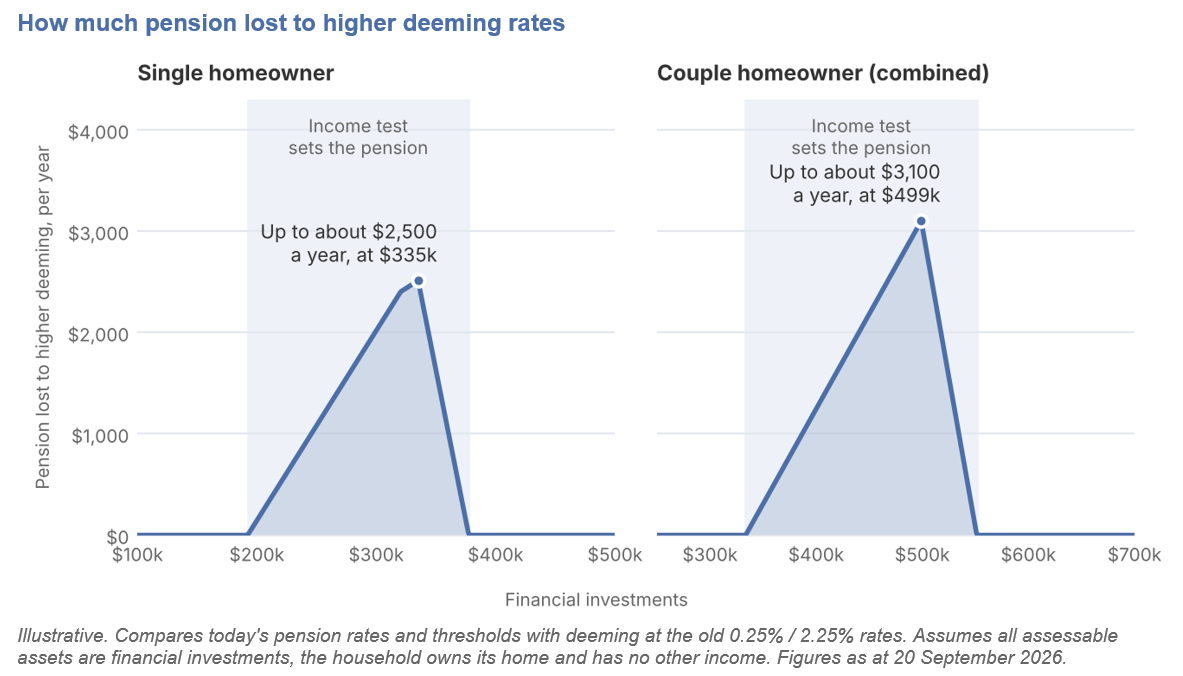
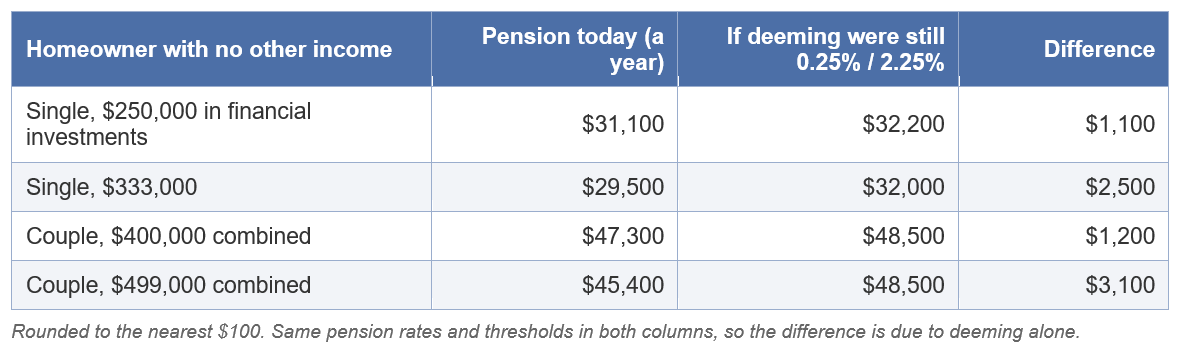
The effect is biggest for people just under the assets test limit, who used to expect a full pension. A few examples:
This is general information, not a recommendation. But a few questions are worth asking:
One caution: be wary of moving money in a hurry to fix a deeming problem. Gifting and deprivation rules, tax, and the knock-on effects for your income and estate can all turn a quick fix into a bigger problem.
If you receive the Age Pension, or you're approaching it, and you're not sure which test sets your payment, get in touch before you make changes to your investments. We can work out which test applies to you and what's likely to happen if the rules move again.
Sources
Services Australia and Department of Social Services, Age Pension rates, thresholds and deeming rates from 20 September 2026; Office of the Australian Government Actuary, deeming rate recommendation (31 July 2026). Examples are Funded Futures modelling and are illustrative only.


This website may contain general advice, but does not take into account your objectives, financial situation or needs. You should consider whether the advice is suitable for you and your personal circumstances. Before you make any decision about whether to acquire a certain product, you should obtain and read the relevant product disclosure statement. In the event that Funded Futures Financial Services is providing personal advice it will be communicated via a ‘statement of advice’.
Funded Futures Financial Planning ABN 81 646 656 804 T/A Funded Futures Financial Services is a Corporate Authorised Representatives and is authorised through Cobalt Advisers Pty Ltd ABN 64 628 654 099 who is an Australian Financial Services Licencee # 512550.
© 2024 Funded Futures | All Rights Reserved | Developed by
