




Access advice to guide your steps
Headlines swing between "downturn", "recession" and "correction", often in the same sentence and often meaning different things. Before you can spot trouble, it helps to know what each word actually describes. Then there is the warning sign that gets far less airtime than the charts: what people start saying when markets or the economy look stretched.
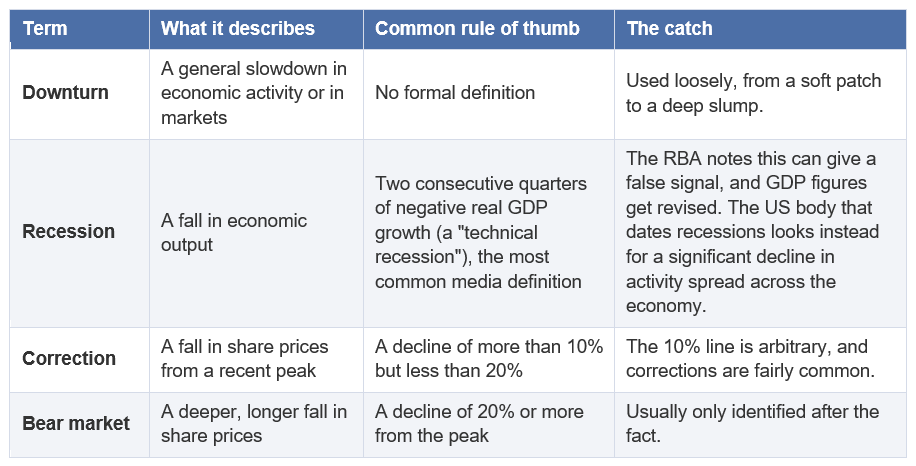
Markets and the economy are different animals. Share prices can fall 10% or 20% without a recession, and an economy can struggle without ever posting two negative quarters. Australia avoided two consecutive quarters of falling GDP when the global financial crisis hit in late 2008. More recently, GDP per person fell for seven quarters in a row through 2023 and 2024, even though total GDP kept growing. Whether those count as recessions depends on which definition you pick.
The most quoted indicator is the yield curve. In the US, the gap between two-year and ten-year government bond yields has turned negative ("inverted") before seven of the last eight recessions since 1968, with lead times anywhere from 7 to 24 months. That is a strong record with a very wide window. The 2022 to 2023 inversion ran for 16 months, the longest in modern history, and had not produced a US recession as at October 2025.
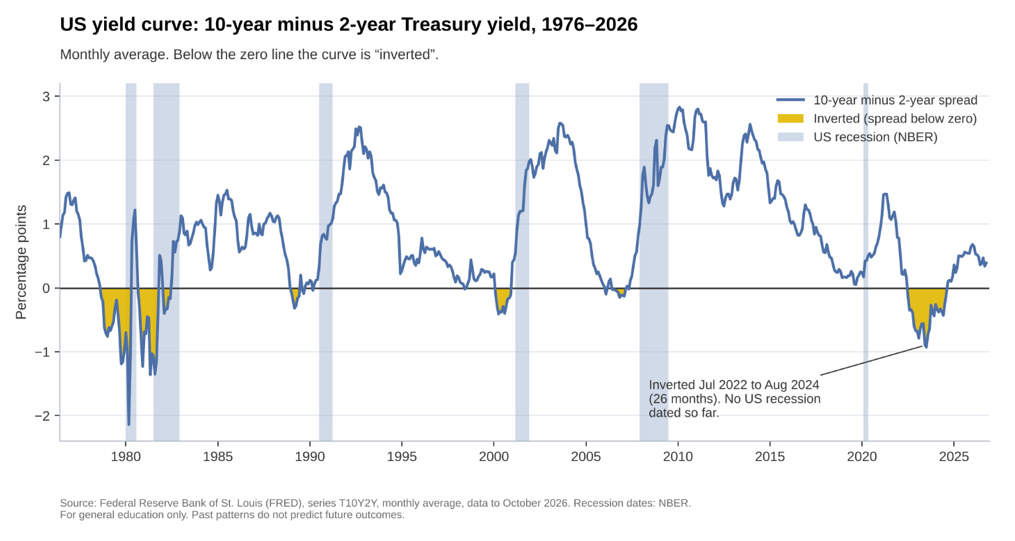
Even the researcher who pioneered the yield curve as a recession signal argued in late 2022 that the signal might be unreliable this time, pointing to labour shortages, real yields that were still positive, and the chance that a signal everyone watches stops working. Valuation measures such as market capitalisation to GDP are similar: they describe how expensive a market is, not when it will turn. Useful context, but a poor stopwatch.
Carmen Reinhart and Kenneth Rogoff studied eight centuries of financial crises across 66 countries. They found that crises strike with surprisingly consistent frequency, duration and ferocity. They also found a pattern in the talk beforehand: each time, experts argued that the old rules of valuation no longer applied. They called it the "this-time-is-different syndrome".
It tends to show up as a story rather than a number. Here are the versions you are most likely to hear, and a question that tests each one.
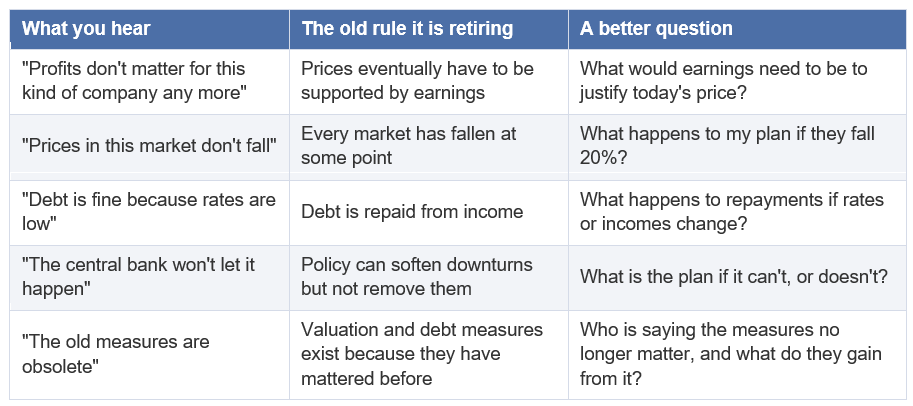
This is a behavioural signal, not a forecasting tool. People said it for years before the share market turned in 2000, and sometimes things really have changed. The phrase does not tell you when. What it tells you is that the conversation has stopped asking what could go wrong, which is when risk is most likely to be underpriced and portfolios are least prepared.
• Don't try to time it. Corrections are normal. In the US there have been 10 since 2000, typically lasting three to four months, and nobody can predict with certainty whether a correction will deepen into a bear market.
• Build for it instead. Know how much of a fall you can live with, hold enough cash for near-term spending so you are never forced to sell, stay diversified, and decide your rebalancing rules in advance.
• Use the phrase as a prompt. When you hear "this time is different", treat it as a cue to check your plan, not abandon it.
If you have never tested your own plan against a 20% fall in markets, or a period of higher unemployment, that is a conversation worth having before the headlines force it.
• HSBC: Australia might have a recession in name only, 6 August 2023
• Mozo: What is a recession, and how can you prepare? (per-capita recession)
• Morningstar: Bear market vs correction
• Schwab: Market correction, what does it mean?
• YCharts: Yield curve inversion 2025, market data as of 29 October 2025
• Capital Spectator: Is the yield curve a reliable predictor of recession?
• Harvard WCFIA: This Time Is Different (Reinhart and Rogoff, 2009)



This website may contain general advice, but does not take into account your objectives, financial situation or needs. You should consider whether the advice is suitable for you and your personal circumstances. Before you make any decision about whether to acquire a certain product, you should obtain and read the relevant product disclosure statement. In the event that Funded Futures Financial Services is providing personal advice it will be communicated via a ‘statement of advice’.
Funded Futures Financial Planning ABN 81 646 656 804 T/A Funded Futures Financial Services is a Corporate Authorised Representatives and is authorised through Cobalt Advisers Pty Ltd ABN 64 628 654 099 who is an Australian Financial Services Licencee # 512550.
© 2024 Funded Futures | All Rights Reserved | Developed by
