




Access advice to guide your steps
Markets are pricing a real chance the Reserve Bank lifts the cash rate again at its 29 September meeting, taking it from 4.35% to 4.60%. NAB has pencilled in a September move, CBA and ANZ lean toward November instead, and Westpac is the lone holdout expecting no further hikes this year at all. The direction isn't really in question anymore; all four majors now expect at least one more rise before year end. The only debate is timing.
Here's my read on what happens next, and it runs against the obvious assumption: I don't think every bank rushes to pass this one on in full. And there's a genuinely good reason why, the market they're lending into today is nothing like the one they were lending into a few months ago.
Back in May, the Federal Budget expanded the First Home Guarantee scheme, no more place limits, no income caps, a 5% deposit with no Lenders Mortgage Insurance for eligible buyers, alongside changes to negative gearing and CGT settings for investors. It landed in the middle of a cash rate cycle that had already delivered three hikes through the first half of the year. And despite that, every one of those hikes was passed on in full, dollar for dollar, by every major lender within about a week of the decision. Nobody blinked, because nobody needed to. Demand was hot enough that a full pass-through barely dented anyone's appetite to borrow.
New mortgage lending dropped $5.4 billion in the June quarter alone, with investor lending falling $4.2 billion; the biggest quarterly fall since 2015. Total new residential lending is down 5% to $97.6 billion for the quarter. Zoom into the banks themselves and it's more pronounced again:
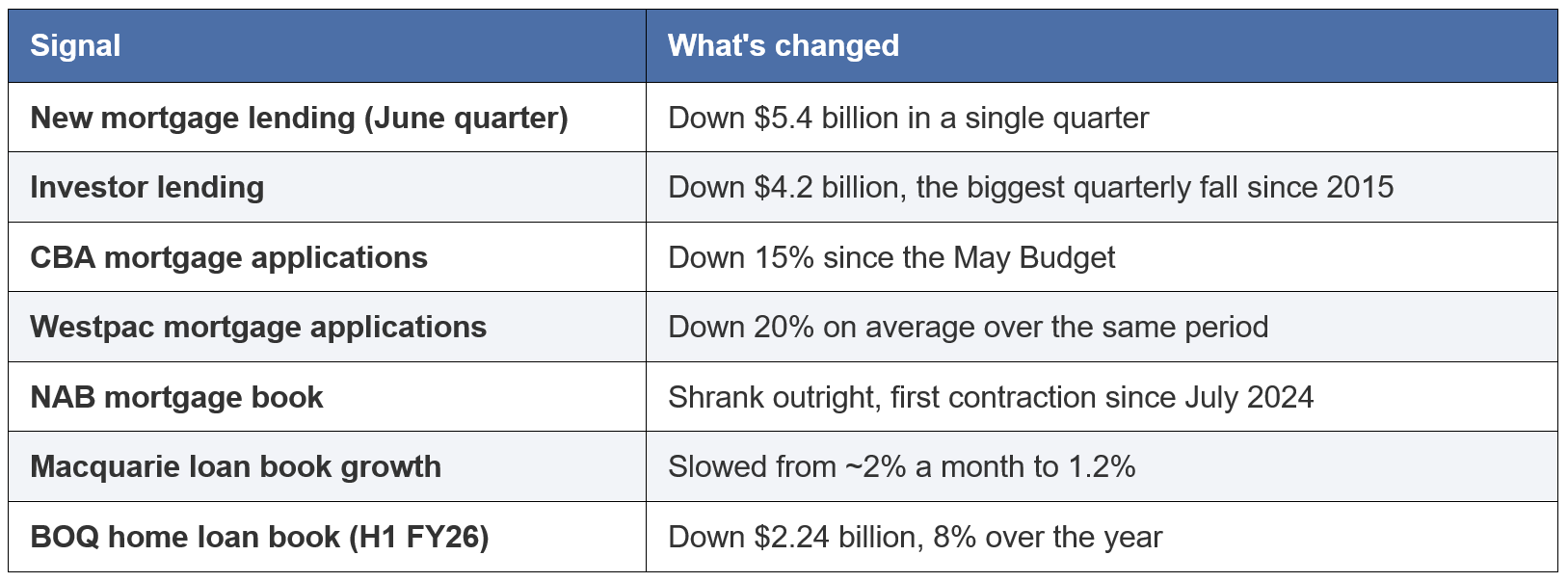
That last stat, BOQ, matters beyond just BOQ. Refinancing hasn't slowed down at all; if anything, it's one of the only parts of the market still running hot, as borrowers who locked in rates during the frothy period start shopping around. Banks aren't fighting to write new loans into a growing market anymore. They're fighting each other to hold onto the loans they've already got.
Every bank's margins are already stretched thinner than the headline profit numbers suggest. Deposit specials and high-interest savings products mean the cheap, sticky funding banks used to rely on isn't as cheap anymore, and funding costs have crept up faster than the cash rate alone would explain. At the same time, banks have been forced to write new mortgages at wafer-thin margins just to defend market share, with new-customer pricing sitting well below what existing customers on the back book are paying. The result: major bank net interest margins compressed a further 3 basis points in the latest half, and loan-loss provisions are climbing to their highest level since the pandemic.
Put all of that together and a full pass-through on the next hike looks a lot less automatic than it did in May. Every bank in this market is trying to hold onto loan book scale while margins are already under pressure, in a market where a chunk of borrowers are actively comparing rates for the first time in years. The bank that's first to announce a full pass-through risks becoming the headline that sends more of its own back book straight into a competitor's refinance offer. Nobody wants to be that headline right now.
My genuine guess, and I won't be happy if I'm wrong, because I'm a mortgage holder too, is we see a split response. Some lenders pass it on in full and rely on retention offers and cashbacks to plug the gap. Others delay the pass-through by a few weeks, or apply it only to new lending while leaving existing customers alone for a beat, buying themselves a news cycle of goodwill while they watch what the market does.
Either way, if you're shopping for a home loan right now, or you haven't looked at your current rate in twelve months, this is about as sharp an environment for negotiating as we've seen in years. Lenders are chasing volume in a shrinking pool, and that competition is worth using.
Over to you: do you think the banks pass this one on in full, absorb it, or split the difference? Have your say on our socials.



This website may contain general advice, but does not take into account your objectives, financial situation or needs. You should consider whether the advice is suitable for you and your personal circumstances. Before you make any decision about whether to acquire a certain product, you should obtain and read the relevant product disclosure statement. In the event that Funded Futures Financial Services is providing personal advice it will be communicated via a ‘statement of advice’.
Funded Futures Financial Planning ABN 81 646 656 804 T/A Funded Futures Financial Services is a Corporate Authorised Representatives and is authorised through Cobalt Advisers Pty Ltd ABN 64 628 654 099 who is an Australian Financial Services Licencee # 512550.
© 2024 Funded Futures | All Rights Reserved | Developed by
