




Access advice to guide your steps
One Nation's proposal to let renters and mortgage holders redirect up to 3% of their compulsory super contributions into take-home pay for up to three years has dominated headlines this fortnight, with predictions ranging from “economically disastrous” to a genuine cost-of-living circuit-breaker. Rather than add another opinion to the pile, we ran the actual numbers.
It's a political proposal, not legislation. No exposure draft exists yet, which matters for the section on structuring risk below.
Using One Nation's own worked example: someone on $90,000 diverting the full 3% each year receives $2,700 gross, or $2,295 net after the 15% contributions tax, about $6,885 in total in-pocket cash over three years.
To see what that actually costs at retirement, we modelled a 30-year-old with a $600,000 mortgage (6% p.a., standard 30-year term) and a $100,000 super balance (7% net return), comparing three years of using the scheme against leaving contributions untouched. Once the mortgage is repaid in either scenario, the freed-up repayment is redirected into super for the rest of the projection, so the comparison isn't unfairly stacked against whichever path pays off the house first.
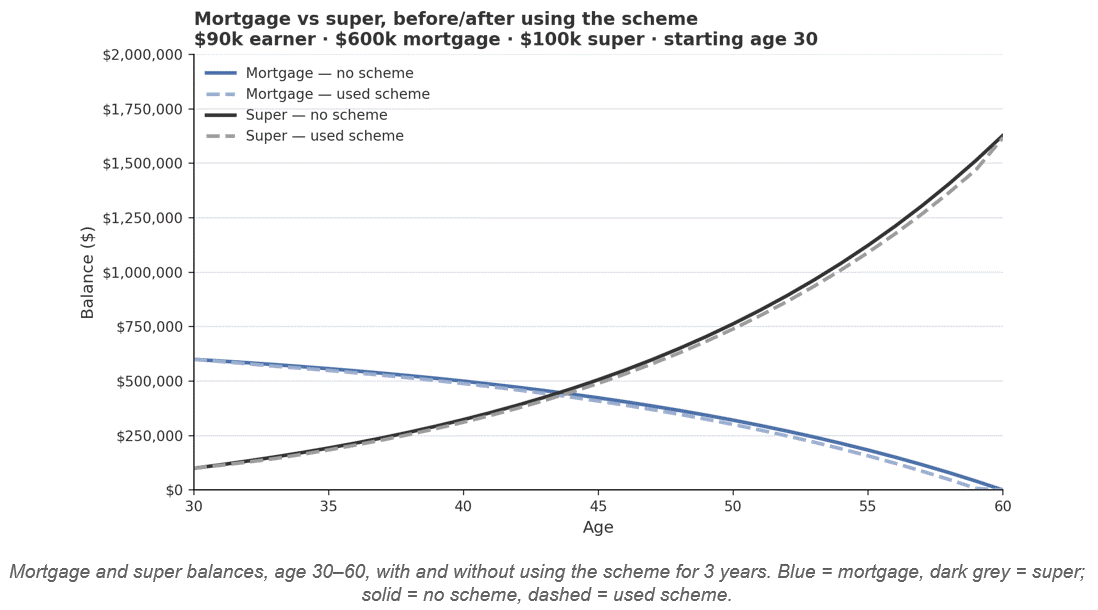
At this scale the four lines are hard to tell apart, which is the point. By age 65 this person ends up with a net position (super minus any remaining mortgage) of roughly $2.59 million without the scheme, versus about $2.57 million having used it, a gap of around $14,900. Real money, but a rounding error against a seven-figure outcome.
A flat 3% of salary means the dollar amounts diverted, and the retirement cost, scale roughly with income. Running the identical model at $200,000:
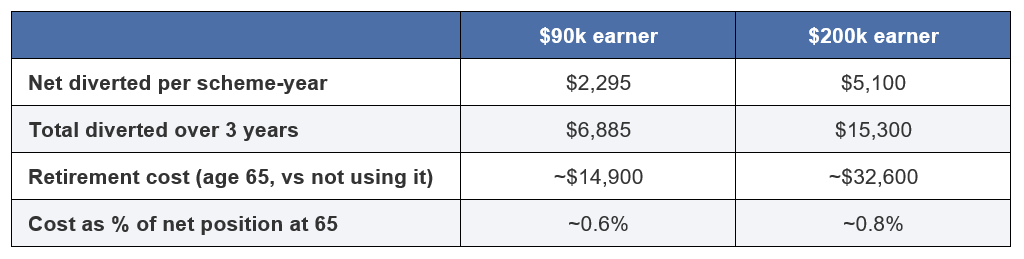
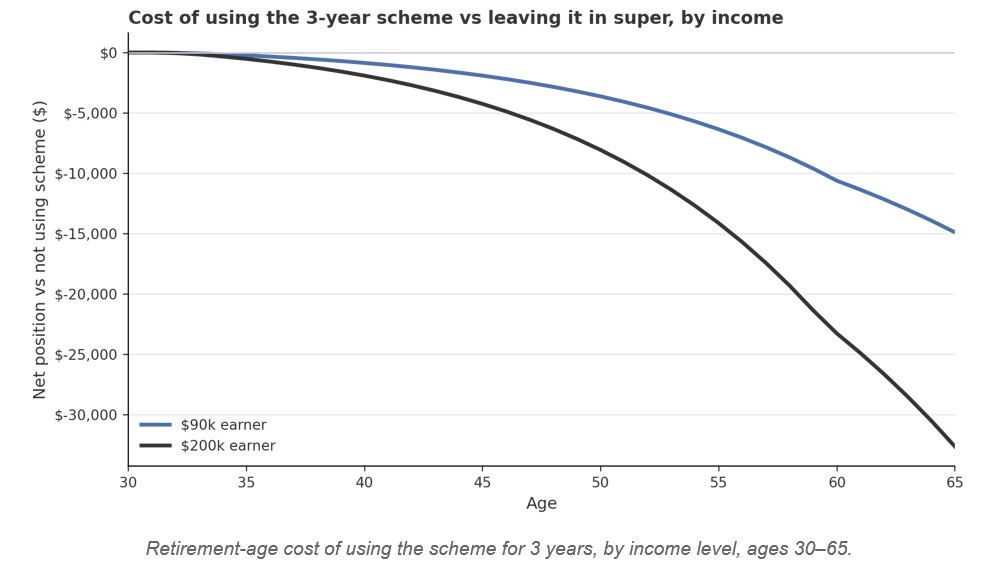
The retirement cost roughly doubles in line with income, unsurprising, since it's the same 3% either way. But the more useful read is what doesn't scale: the cash-flow relief. $5,100 net over three years barely moves the needle for someone earning $200k, while for the $90k earner it's a meaningfully larger share of a tighter budget. This is a policy that gets less useful the more you earn, in both directions, high earners get a rounding-error benefit for a rounding-error cost, while the people it's aimed at have the least room to absorb a cut to compulsory savings if their circumstances change.
Every piece of commentary on this policy has quoted the Super Members Council's retirement-cost modelling. None has addressed the structuring question; and it's the one that actually determines whether this could work as drafted.
We've been here before. During the COVID-19 early release scheme, the ATO explicitly flagged people who artificially arranged their affairs to meet eligibility criteria, and specifically called out members withdrawing and re-contributing super for a tax advantage; warning this could trigger anti-avoidance provisions on top of additional tax and integrity consequences. That was the system closing a loophole after it had already been exploited.
One Nation's explainer says the 3% comes out of the 12% compulsory SG — but nothing published so far clarifies whether the eligible pool is limited strictly to SG, or could extend to voluntary salary-sacrificed contributions too. If it's the latter, or simply undefined, the structuring play writes itself: increase salary sacrifice (cutting current-year taxable income at your marginal rate — often worth more than the 15% saved on the SG-only slice), then draw part of it back out concessionally taxed via the pay boost. That isn't “accessing your future super early.” It's minting a bigger current-year deduction and partially reversing the lock-up; precisely the pattern the ATO targeted in 2020–21.
Given that precedent, any serious drafting of this policy would need an integrity rule closing this off, most likely by ring-fencing eligibility to the mandated 9%/3% split and excluding voluntary concessional contributions from the calculation. Until that's specified, treat every dollar figure attached to this policy, including ours, as provisional on the fine print.
We wouldn't use this to cover rent. Paying down a mortgage at least converts the withdrawal into equity, it still moves your net wealth position, just via debt reduction instead of super growth. Rent is pure consumption; diverting future retirement savings to cover it doesn't build anything on either side of the ledger, it just moves money from a pot you can't touch yet into a pot that disappears. Your money, your call; but it's worth sitting with that distinction before opting in.



This website may contain general advice, but does not take into account your objectives, financial situation or needs. You should consider whether the advice is suitable for you and your personal circumstances. Before you make any decision about whether to acquire a certain product, you should obtain and read the relevant product disclosure statement. In the event that Funded Futures Financial Services is providing personal advice it will be communicated via a ‘statement of advice’.
Funded Futures Financial Planning ABN 81 646 656 804 T/A Funded Futures Financial Services is a Corporate Authorised Representatives and is authorised through Cobalt Advisers Pty Ltd ABN 64 628 654 099 who is an Australian Financial Services Licencee # 512550.
© 2024 Funded Futures | All Rights Reserved | Developed by
