




Access advice to guide your steps
You picked up the extra shift. You checked the payslip. And a big slice of that overtime has vanished before it reached your account. It feels like overtime is taxed at a special, harsher rate. It isn’t, but the way tax is taken out of each pay does make it look that way.
There is no overtime tax rate in Australia. Overtime is added to your other income and taxed at the same rates as the rest of it. What changes is the tax your employer withholds from that pay, which is an estimate. Your actual tax bill is settled when you lodge your return.
Overtime pays tax at the same rates as the rest of your income. Since 1 July 2026 the rate on income between $18,201 and $45,000 has dropped from 16c to 15c in the dollar, with a further cut to 14c scheduled for 1 July 2027. These are the ATO’s resident rates for 2026–27:
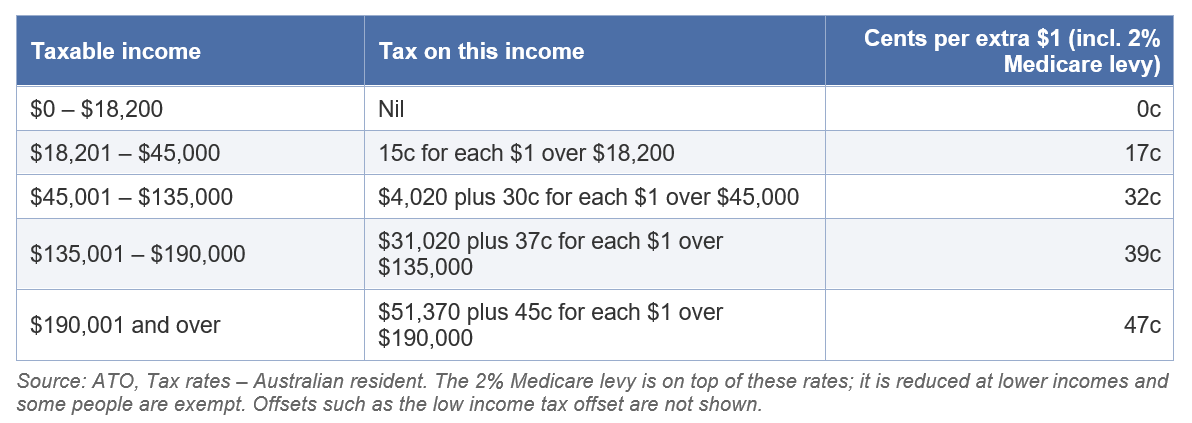
Your employer doesn’t know what you will earn this year, so they use the ATO’s tax tables. There is a table for each pay frequency: weekly, fortnightly, monthly, and one for daily and casual workers. The amount withheld depends on your pay for that period and on whether you claimed the tax-free threshold on your tax file number declaration. The ATO updated all of them from 1 July 2026 to reflect the new rates.
Here is the catch: each table treats your pay as if you will earn that amount every pay, all year. A normal week and a big overtime week are each looked at on their own. A week with overtime in it looks like a higher income, so the table takes tax at a higher rate on that pay.
Take someone paid $1,634 a week (about $85,000 a year) who works an extra $400 of overtime in one week.

The $128 withheld on the overtime is 32c in the dollar. That isn’t a quirk of the tables. It is this person’s real rate: 30% tax plus the 2% Medicare levy. Over the year the overtime is taxed the same way, so no refund is waiting. The overtime just keeps 68c of every dollar, as the rest of the pay does.
Now take someone paid $700 a week (about $36,400 a year) who has one big overtime week of $600 on top.

Here $170 was withheld, which is 28c in the dollar. But the year’s income only moves from about $36,400 to $37,000, and that extra $600 sits in the 15% bracket. The tax actually owed on it is about $102 (15c plus 2c Medicare levy, so 17c). The table treated that week like a $67,600-a-year pay packet, so about $68 too much was taken out. It comes back when you lodge your return, if nothing else in your year changes.
• Lumpy pays are over-withheld. One big week is treated as if it repeats all year, so extra tax is taken early and comes back at tax time.
• Overtime usually doesn’t earn super. Employer super guarantee (currently 12%) is based on ordinary time earnings, and the ATO says overtime payments are not part of them. Some awards and agreements do provide for super on overtime, so check yours.
• A study loan adds to the bite. If you have a HELP or similar debt, extra income can lift your compulsory repayment.
• It can go the other way. If you work two jobs, or didn’t claim the tax-free threshold correctly, too little tax can be withheld and you may owe money at tax time.
Use the current table for each payee’s pay frequency, and the ATO’s withholding lookup tool if you want to check an amount. The ATO also says to let fortnightly payees know when there are 27 pays in a year. Tables and tools: ato.gov.au/rates/tax-tables.
If overtime, penalty rates or shift loadings are a big part of your income (rosters, FIFO, trades, healthcare), it is worth working out what your pay really looks like over a whole year, including tax, super and any study loan. Get in touch and we can talk through how it applies to you.



This website may contain general advice, but does not take into account your objectives, financial situation or needs. You should consider whether the advice is suitable for you and your personal circumstances. Before you make any decision about whether to acquire a certain product, you should obtain and read the relevant product disclosure statement. In the event that Funded Futures Financial Services is providing personal advice it will be communicated via a ‘statement of advice’.
Funded Futures Financial Planning ABN 81 646 656 804 T/A Funded Futures Financial Services is a Corporate Authorised Representatives and is authorised through Cobalt Advisers Pty Ltd ABN 64 628 654 099 who is an Australian Financial Services Licencee # 512550.
© 2024 Funded Futures | All Rights Reserved | Developed by
