




Access advice to guide your steps
My kids pay a higher marginal tax rate than I do. On investment income, a child under 18 can be taxed at 45%, the same top rate that applies to adults earning over $190,000 a year.
That's not a mistake, and it's not a loophole running in reverse. It's a deliberate rule designed to stop adults parking investment income in their children's names. But it catches ordinary families too, and it has a nasty second layer: the moment a teenager gets a part-time job, their wages are taxed one way and their savings and shares another way, on the same tax return.
For tax purposes, you're a minor if you're under 18 on 30 June of the income year. A minor's income is sorted into two buckets, and each is taxed differently:
• Earned ("excepted") income: wages and salary from a job, and income from a business the child genuinely runs. This is taxed at normal adult resident rates, including the $18,200 tax-free threshold.
• Unearned ("eligible") income: interest, dividends, rent, trust distributions and capital gains. This is taxed under special minor rates that start at nil and quickly climb to 45%.
A narrow group of "excepted persons" (the ATO defines who qualifies, and it's narrower than most people assume) are taxed at adult rates on everything. This article is about the typical child who isn't one of them.
These are the ATO's tax rates for a resident minor's unearned income. They have been unchanged since at least 2020–21, and the ATO's current table is the 2025–26 one.

Two features matter. The $417 to $1,307 band has a 66% marginal rate, which is higher than any adult rate. And once income passes $1,307, the 45% applies from the first dollar, not just to the excess. There's no $18,200 tax-free threshold here, and the low income tax offset can't be used against it either.
Here is what that looks like in dollars (before Medicare levy):
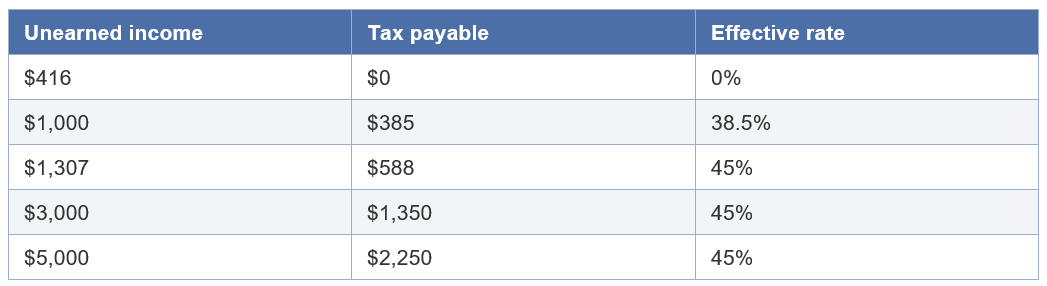
For comparison, $5,000 of extra income taxed in the 30% adult bracket costs $1,500. In the 37% bracket it costs $1,850. The child pays $2,250.
Take a 16-year-old with a part-time job and a small investment account in their own name. Over the year they earn $12,000 in wages and receive $2,000 of dividends and interest.
• Wages, $12,000: under the $18,200 tax-free threshold, so $0 tax.
• Unearned income, $2,000: 45% of the entire amount, so $900 tax.
Their wages leave $6,200 of the tax-free threshold unused, and it can't be borrowed. The threshold only works on the earned bucket. An adult with the same $14,000 of total income would pay nothing. The teenager pays $900.
That's the trap. For this teenager, the next dollar of wages is taxed at nil and the next dollar of dividends at 45%. Same person, same tax file number, same tax return, and a 45 percentage point gap between the two kinds of income. Earning more from the job doesn't change the rate on the dividends.
The minor rates exist to discourage income splitting. Without them, a high-income parent could put investments in a child's name and use the child's tax-free threshold and lower brackets to cut the family's tax bill. The ATO describes the rules as a measure to discourage adults diverting income to their children.
The cut-off is a date, not a birthday. The test is whether the child is under 18 on 30 June of the income year. A child who turns 18 in May is taxed at adult rates on all of that year's income. A child who turns 18 on 1 July is still a minor for the whole of the year that just ended.
None of this says children shouldn't have savings or investments. It says the tax outcome depends on whose name the income lands in, and that's worth knowing before the money is invested rather than after the tax return arrives. Four questions worth asking:
• Whose name is on it? Income from an investment in a child's name is taxed to the child at the minor rates. The same investment held by a parent is taxed at that parent's marginal rate, which may be lower than 45%. But ownership and control then sit with the parent, and that has its own consequences.
• How much income will it actually produce? Most kids' bank accounts earn a few hundred dollars of interest a year and never reach the $416 threshold. The problem starts when balances, dividends or distributions get larger.
• When might something be sold? A capital gain a minor realises is unearned income, so the timing of a sale can matter as much as the size of the gain.
• Is a different structure a better fit? Distributions from a family trust to a minor run straight into the same rates. Other approaches, such as investment bonds or superannuation for a working teenager, work differently, and each comes with its own costs, rules and trade-offs. None of them is a free lunch.
What's right depends on the family's position, what the money is for, and how long it will be invested.
If your children already hold savings, investments or trust distributions in their own names, or you're thinking about setting something up for them, it's worth looking at who is being taxed, and at what rate, before the next tax return. Get in touch with the team at Funded Futures and we'll walk through your situation with you and how we can potentially lower the amount of tax paid while still saving up for your children’s education/first car/house deposit/etc.
• Tax rates if you're under 18 years old (ATO), last updated 1 June 2026
• Your income if you are under 18 years old (ATO)



This website may contain general advice, but does not take into account your objectives, financial situation or needs. You should consider whether the advice is suitable for you and your personal circumstances. Before you make any decision about whether to acquire a certain product, you should obtain and read the relevant product disclosure statement. In the event that Funded Futures Financial Services is providing personal advice it will be communicated via a ‘statement of advice’.
Funded Futures Financial Planning ABN 81 646 656 804 T/A Funded Futures Financial Services is a Corporate Authorised Representatives and is authorised through Cobalt Advisers Pty Ltd ABN 64 628 654 099 who is an Australian Financial Services Licencee # 512550.
© 2024 Funded Futures | All Rights Reserved | Developed by
